 |
 |
||
 |
|||
|
|
||
|
|||
 |
 |
Topeka TV Reception |
|
The purpose of this document is to help the
typical local TV viewer in the Topeka area in obtaining good television
reception. The author of this paper is a broadcast engineer,
unaffiliated directly with any of the Topeka or K.C. TV stations, but
has been a TV engineer for many years and lives in the Topeka area. The
views herein are not necessarily the views of any of the broadcast
entities mentioned. The
basics Even though the channel numbers on a TV are
continuous, the actual frequencies used are not all together in one
frequency band. There are actually three bands, Lo VHF, Hi VHF, and UHF.
Lo VHF consists of channels 2 thru 6 and are from 54 to 88 MHz just
below the FM radio band. As such these channels are the best at bending
over the horizon, but are also the most susceptible to noise from
lightning, power lines and the like. Hi VHF band contains channel 7 thru
13 cover 174 thru 214 MHz, and are less susceptible to noise, but are
more line of sight dependent. The UHF band for TV contains the lion’s
share of channels 14 thru 69 cover 470 thru 804 MHz. This is the least
noise susceptible band but is also much more dependent on line of sight
to work well. As a side note here, as part of the FCC’s master plan
for conversion to DTV, channels 2 thru 6 and 52 thru 69 will be vacated
and used for other services. Topeka and the surrounding area is in a somewhat unique situation, being a separate TV market but still being within reception range of a major metropolitan market. As such the reception problems this co-location generates are likewise unique. So some education of the general TV viewer is in order so that they can get the most out of their D TVs. Proper use of set top antennas The "why" of this will be covered later on. For now here are some easy tricks to help use a set top antenna in Topeka. 1) Make sure it's got "rabbit ears". Those are the extendable whip antennas for picking up VHF signals. If your set top antenna doesn't have this, chances are it won't receive any of the VHF signals (WIBW 13 and KTWU 11). 2) If the antenna has extendable whips set them flat/horizontal and make the distance between them to a total of 28 inches. This will put them at the proper length to receive the best WIBW and KTWU signal. 3) Since WIBW is due west of Topeka about 13 miles distant, the antenna needs to be oriented so it's broadside is toward the West. In other words, the whips need to point pretty much North/South. Of course some variation on this will need to be found for KTWU, who's transmitter site is on the North end of Wanamaker Road. 4) If the set top antenna has a preamp that's adjustable it may be adding distortion by picking up extraneous radio noise. Set the gain for minimum then if you get a low signal turn it up a bit at a time rescanning between settings. 5) If you're also dealing with some flavor of DVR, DirecTV or Dish Network satellite receiver or TIVO. There are other issues. These providers program their boxes partially by what they receive over the air and partially by a channel list provided by them. Some have been a bit slow on the uptake to provide the programming upgrades. In some cases using the reset button or perhaps unplugging the unit for an hour or two (simulating a power failure) may cure this problem. But remember, just cause one of these boxes doesn't get a signal after scanning doesn't necessarily mean the signal isn't there. The ONLY real test for signal from an antenna is a set top converter box or a DTV ready TV. DTV channel assignment information: Topeka and Kansas City Remember
as you read this that these are the REAL channels (frequencies) being
used. The numbers usually displayed on DTV sets are the numbers provided
in the PSIP information transmitted by their respective DTV
transmitters. So for example both WIBW-DT on channel 13 AND on UHF
channel 44 will read out as 13-1 and 13-2. As of this writing to the
best of my knowledge the Topeka and K.C. channels use the following DTV
channel assignments: KTWU uses their old analog allocation as DTV channel 11. WIBW uses both DTV channel (44) and their old analog allocation as DTV channel 13. KTKA uses their old UHF analog channel as DTV channel 49. KSNT uses their old analog allocation as DTV channel 27. KTMJ is a low power station and continues to be analog on UHF channel 43. However it’s programming is available from its sister station KSNT on their channel 27-2. WDAF is actually on DTV channel 34. KCTV is actually on DTV channel 24. KMBC is on DTV channel 29 (the old KCWE analog channel). KCPT uses DTV channel 18. KCWE uses DTV channel 31. KMCI uses the old KSHB UHF channel 41 analog allocation as DTV channel 41. KSHB uses DTV channel of 42. KSMO uses DTV channel 47. So, in short, there are NO VHF low band DTV stations in either the K.C or Topeka markets. Only Topeka channels 11 and 13 will remain on VHF High band, and all the K.C. stations are on UHF channels. DTV: Some finer points to be mentioned... There
are many set top antennas claiming to be HDTV/DTV ready. They are in
fact UHF only antennas. And there are a lot of outside DTV
antennas that are UHF only too. (or have very minimal VHF reception.) I
know in other markets some major retailers have been pushing UHF only
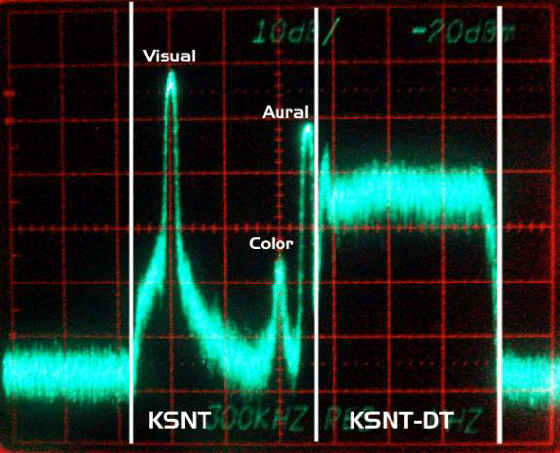
DTV antennas claiming they're OK. I know this antenna mis-marketing was the driving force behind KMBC in K.C. choosing to abandon their DTV channel 7 and go to DTV 29. They were swamped with reception issue calls during the transition period. I also know in other markets, where VHF high band DTV signals are being used as their primary DTV assignment (as in the case of WIBW-TV and KTWU) this has also been a major issue..... Some of these stations are taking the action of either reactivating their temporary UHF DTV (as WIBW did) or are completely rebuilding their operations to be UHF only on a new channel. So in any particular case this may or may not be an issue. But be aware that just cause an antenna says its HDTV ready, doesn't necessarily mean you will be able to receive VHF DTV signals reliably. The remaining of this page was first written to cover older analog TV reception, and has been update for the new world of DTV. But all the concepts, as well as the station's locations, are the same. Consequently much of the information is still relevant. Some details: For those who wish to know more..... DTV relies on converting the picture to numbers, lots of zeros and ones. This is the same process in many ways as is used in digital cell phones or WiFi connections. And to clarify, HDTV (high definition TV) and SDTV (standard definition TV) also known at DTV use the same transmission scheme. The only difference is how many bits of information are shoved into the pipe. This digital technique means the power used to carry the signal is spaced out equally all across the band. To put a picture to this, below is a spectrum
analyzer photograph, shot during the transition period, showing KSNT and KSNT-DT. This is really a graph
with the horizontal line showing frequency whereas the vertical scale
shows power. The left is the lowest frequency whereas the right is the
highest frequency. The photo clearly shows the visual and aural carriers
of the analog signal whereas the digital channel is the large
rectangular bump on the left with energy shared equally all across the
6MHz channel band.
So
now on to specific channels….
East side, west side, outside of town….
Now that the DTV transition has taken place all the
Kansas City DTV stations are in the UHF band. According to their coverage charts the best
of them just reach the east Shawnee County line. But hope springs
eternal in the heart of the TV viewer and it is possible to get these
stations in parts of Topeka. Generally speaking, a viewer east of
Indiana St. with a good UHF deep fringe antenna at least 30 feet up,
with a preamp, on high ground can receive these stations most of time.
There are some exceptions I’ll mention later. Anywhere west of this
line it becomes more and more difficult where by Fairlawn St. the odds
of reception dwindles…Remember the earth curves and there is some
pretty decent high ground between Topeka and Lawrence, this works
against the signal. Viewers North of the Kansas River are a bit luckier.
In their geographic location the signals from the K.C. stations skim
down the Kansas River bottom and as such can go a bit further west. But
Much west of US 75 and the signal is gone. Your
Mileage may vary…. Now for the exceptions, Channel 42, the DTV signal from KSHB, is parked next to channel 43 KTMJ and as such the receiver’s tuner just can’t lock to the distant signal reliably. Now that being said, there may be areas, on the Eastern edge of Topeka where these signals may be viewable on a case-by-case basis. There’s
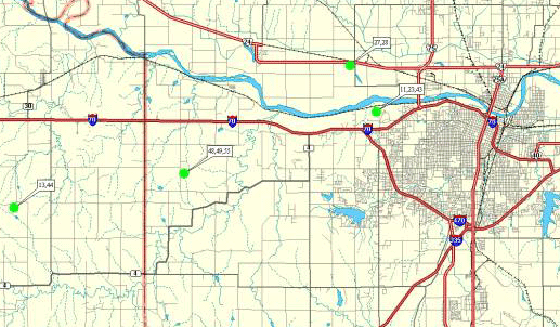
no place like home….The Topeka Stations: Well here it’s a bit easier you would think, but
this is not always the case either. To start with here is a map showing
the location of the Topeka stations.
Channel 11’s tower at the North end of Wanamaker is the home of both KTWU's DTV transmitter as well as the KTMJ transmitter. The KSNT tower North of the river on highway 24 holds their DTV transmitter. The KTKA tower west of Topeka at 23rd and West Union Road, holds the KTKA DTV antenna as well as the K33 LPTV antenna. Finally, WIBW is located several miles South of the Maple Hill exit on I-70 in Wabaunsee Co. It holds both the WIBW digital antennas. So, depending in where you live in or around the city the various transmitters may not be in the same direction. This is a bad thing. As any viewer knows so well, the placement of the antenna is what gets rid of ghosts. Remember playing with rabbit ears to find the best picture? This is not so much an issue of signal strength but more one of minimizing the unwanted reflecting signals that show up as ghosts. This same thing happens with outside antennas not pointed toward the transmitting tower, ghost signals, also called multipath, can tear up an otherwise strong signal. As a side note here, don’t be fooled by folks who say DTV doesn’t have ghosts, well no, not that you can see BUT these multipath signals can and do strongly affect the reception. These multipath signals can cancel out parts of the received signal and make it very hard for DTV receivers to detect the data properly. So these digital ghosts show up as unreliable signal and will cause the DTV receiver to show a “blue screen of death” right in the middle of that all-important game. When DTV is good it’s great, when the digital signal is marginal, it simply goes away. This by the way is known as the “cliff effect” referring to the fact the signal is either there or not, rather than the cliff a viewer wants to jump off when the all important show is missed. So in Topeka proper, it may work to have just one
antenna for 11 and 13 and one antenna for the UHF channels. Or, if you
live on the west side of town, a couple of antennas to get each set of
signals cleanly, remember ghosts kill DTV too. The FCC’s “gift” to Topeka’s viewers….
Ok now on to the real bailiwick in Topeka TV
viewing. Something the FCC didn’t think about. The idea of adjacent
channels was addressed by the FCC making some assumptions, that the
stations were co-owned and co-located. This would allow one, common
engineering staff to make sure the proper equipment and techniques are
used so the typical viewer gets both stations cleanly. Then, the FCC
promptly overlooked the low power class A stations, of which KTMJ is
one. So all the safeguards went right out the window….. KTMJ is a
class A station and as such is limited on the amount of power they can
broadcast. It’s not their fault; this is the way the FCC set up the
rules. And WIBW is required by the FCC to cover their entire viewing
audience with their DTV signal on channel 44. This makes their signal
strong. Again it’s the FCC rules it’s not their fault. BUT what this
means is there’s a big old DTV transmitter putting out what looks like
snow right next to lower power KTMJ on channel 43. So neither station
wins this battle. KTMJ has a strong signal over Topeka but typical TV
tuners also see the digital snow from WIBW DT on channel 44 and the picture looks bad.
And before you think WIBW DT channel 44 is all bad, the analog signal from KTMJ
affects their digital signal too. The analog signal makes it harder for
DTV receivers to lock on to the proper signal and the consequence is the
viewers at home get the dreaded “blue screen of death”
out of their DTV sets….. Remember, it’s NOT either of the station’s
fault, they are controlled by FCC regulations. This situation will solve itself in some way
when KTMJ eventually converts to DTV. Remember this before you pick up the phone or sent them
email..…. Stay
tuned for further developments. Just
a quick reminder…. Remember the Topeka TV stations didn’t create the
problem, they know it’s there, and are reticent to talk about it. It’s
an FCC thing. And out of their hands. Now before you throw up your hands and just get a satellite dish. This won’t necessarily fix your HDTV reception problems either. A short side trip: How DTV signals get on satellites and cable.... I thought a short side trip into the world of how DirecTV, Dish Network and cable providers actually get their signals from local stations might be useful here. Firstly for cable. WIBW, KTWU and KTKA provide a separate signal, via fiber, to Cox in Topeka. Cox takes those signals, again via fiber, to Manhattan and Junction City cable systems. I'm not sure how KSNT and KTMJ signals make it to cable currently. So it's possible for those station's transmitters to be off and still have programming on Cox. Other, non Cox, cable providers receive the signals over the air and just repeat it thru their systems. So a transmitter failure wipes them out too. In some cases these providers also down convert over the air signals to standard definition also. You can now see that in some cases having cable may not give you any better signal than a simple antenna system would provide. I've worked on both the satellite local ingestion sites but won't disclose their locations. But I can explain how this all works. Hopefully this will explain to viewers why sometimes the satellite providers can have signal issues.. Back in the days of analog TV the FCC required that local stations be available as signals on the satellite from the big two providers. To meet these needs each provider built a "local ingestion" point where all the over the air signals could be received. These signals were then shipped on a high speed fiber optic link back to their broadcast centers, where they're uplinked to the satellites. Some of these sites were provided signals directly from the TV stations (pre transmitter) while others were received over the air, just like the folks at home. So for example if WIBW was off the air so was the signal on Dish Network and DirecTV. Whereas if KTWU was off the air it may not be off on DirecTV. When DTV was implemented both Dish Network and DirecTV got agreements to carry only the standard definition DTV signals from local TV stations, and in some cases don't pass it as high definition or secondary channels. This is changing but slowly. But it also means that a viewer may not get an HD signal off of satellite. What I'm saying here is that, depending on the provider and the channel being viewed, a failure may or may not wipe out a signal. And a signal may or may not be available in HD.... This means that, at least for local HDTV, just switching to cable or satellite may not necessarily be the best answer.... Where
to start…. Now that you know the gory details you can see that
to get the most out of your New HDTV set,
receiving the local over the air DTV signal is a must. “So what do I DO!” You ask
yourself. Do not despair. It is possible to get local TV all that is
needed is a plan. Firstly, a little pre planning goes a long way.
Figure out where each TV tower is relative to where you live. It may be
possible to get all the stations with two or three antennas. It may even
be worth buying one antenna, which you plan to use, and try pointing it
around at each of the stations from ground level while hooked up to some
sort of portable TV. This is a pretty good indicator if you’re going
to have problems with the final installation. If the signals look good
on the ground, they should be even better from the attic or on the roof. OK picking an antenna, in this case bigger is
better. Antennas get their gain by eliminating signals from other
directions. This makes the wanted signal better and off angle signals,
the multipath mentioned earlier, weaker. Amplifiers amplify both the
signal and the noise but an antenna selects just the wanted signal. It
you have the luxury of being able to mount the antennas outside by all
means do so. No need to loose most of the signal going through roofing
if you don’t have to. Even for local stations a small mast outside
could mean the difference between a great signal or a mediocre one. One
other point here, if the antennas are outside it should be grounded
properly as the directions with the antenna recommend. This is to
protect against lightning damage. Attic
installs…. Well as you may have guessed the higher the antenna
the better, at least for getting distant signals, but it some cases this
can’t be done. Antennas placed in attics loose 60% to 80% of their
signal going through the roofing material. This loss is greater on UHF
signals. But in some cases, where there are home association covenants,
this can’t be helped, the attic is the only place for an antenna. In
these cases it’s important to make sure the antenna is still aimed
properly to the station of interest. Make it louder….
Amplifiers boost the signal but can cause problems
all their own. Firstly there are actually two types of amplifiers,
preamplifiers also known as preamps and line or distribution amplifiers.
Preamps are used to boost the signal from the antenna to the
distribution amplifier. These are sensitive but not meant to produce
lots of power. Here bigger isn’t necessarily better. In fact, using
the highest gain preamps can cause more problems than they solve. They
can overload from stronger local signals and make the weaker, distant
signals unwatchable. Use them only as needed. Distribution amplifiers
serve a different function they take the combined signals,
amplify them split them to several TV sets. They have less gain
and are meant to get the signal to each set adding only enough gain to
make up for the loss in signal in the cable and the splitting process…They
also accept high signal level without overloading. Using the proper
amplifier type for the proper use can improve quality, while misuse will
certainly cause reception problems. Filters
and combining the signals…. There are filters available to pass only one of the
TV bands or to block only one channel. These filters can be helpful in
allowing only the wanted signal into the system while blocking unwanted
signals. An example here is if you live on the western edge of the city.
KSNT would be due North whereas KTKA is due West. Pointing the antenna
North would give a great picture for KSNT but have digital ghosts on KTKA and
visa versa. The solution is to put up two smaller UHF antennas one
pointed to KSNT the other pointed to KTKA. Then two UHF band pass type
filters are used, one in the line from the KSNT antenna which would pass
that signal and a similar filter on the West antenna to allow only the
KTKA signal thru. Then both signals would be
combined to get two great signals. So the trick here is to let the good
signal pass and block the bad ones with filters. These TV bands can also be combined with a band
splitter/combiner filter. This device has three ports (inputs), one for
each band, and one combined output. These are good for keeping any UHF
stray signal from a VHF antenna from passing a poor UHF signal or visa
versa……These devices are available at the same store where you get
the antennas…… Don’t scrimp on the basics……
Make an effort to use good RG-6 type 75-ohm coax.
Coax comes in all types but RG-6 is shielded properly and has less
signal loss than other types. Using this will insure the signal you do
get makes it to the TV set cleanly and with the strongest signal
possible. For
the advanced hobbyist…… There are other, fancier devices that can improve the signal further, but a good understanding of TV is needed to use these. One device is called an XUV channel converter. They only convert UHF channels to VHF channels hence the name. These would let you move any of the UHF DTV channels to open VHF channels (rather than using channel band pass filters I mentioned above) Another device that comes in handy is called a
modulator. This device takes the video and audio from a satellite
receiver, VCR, or DVD, or
video game, or even a home security camera and converts it to an open TV
channel. With this device you can add you own channels to your TV
system, allowing the source to be viewed all over the house. Lastly, if you plan on getting this deep into a
home TV system it’s worth it to get some sort of signal meter to both
check levels at each set or to check for any possible interference of
antennas. Good
luck…. You now have a good start on knowing how to get all
the Topeka DTV stations cleanly. And have a pretty good feel
if you can possibly get the K.C. stations where you live also. Depending
on your need for TV you can make your TV watching choices as grand or as
limited as you desire. I hope you find this useful. Happy viewing. Other
links to more info…. Lastly, if you want to learn more here are some
helpful web sites. http://www.picomacom.com/macom/home/
|
|
  |
| Copyright © 2007 Krohe Electronics Corp. All rights reserved |